
 For several decades, the potential regenerative powers of stem cells have excited researchers. Yet effective applications have felt out of reach amid struggles to achieve potency and durability at the targeted site and concerns about the potential of migrating stem cells.
Recent advances in programming human-induced pluripotent stem cells (hiPSCs) at The Ohio State University Wexner Medical Center are reviving high hopes. At the tip of that spear is work being done by Mahmood Khan, PhD, M. Pharm, on a 4 centimeter by 4 centimeter cardiac patch that is successfully improving cardiac function in large animals with heart damage.
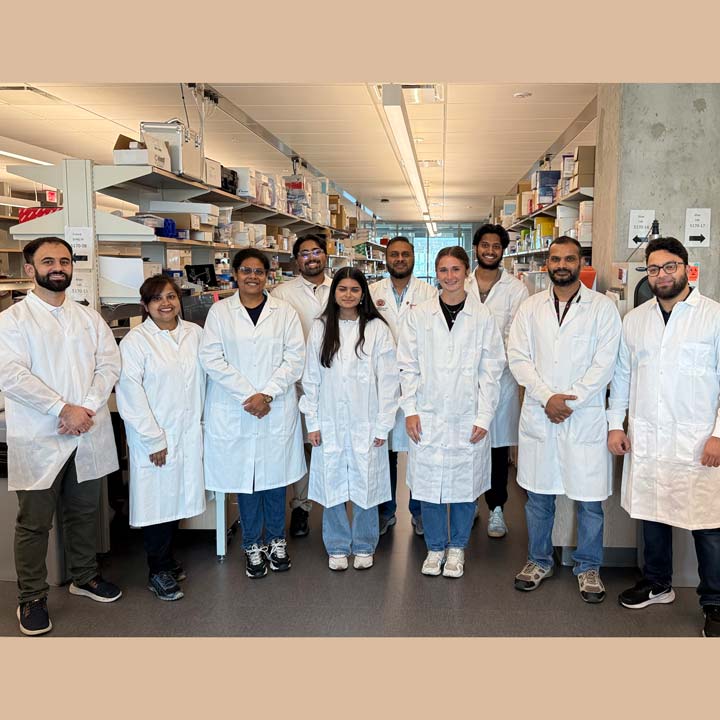
Dr. Khan is a professor and division director of basic and translational research within the Department of Emergency Medicine. His 20-year history of investigating cardioprotective mechanisms at The Ohio State University Dorothy M. Davis Heart and Lung Research Institute has moved the needle forward for potential therapies.
“The Ohio State Davis Heart and Lung Research Institute has fostered my career, providing an environment that enables leaps forward in the cardiac field,” Dr. Khan says.
Novel technology reverses heart attack damage
Dr. Khan explains that from the moment a heart attack occurs, the left ventricle begins to remodel, often forming scar tissue that replaces healthy cells, leaving them non-contractile. Current medical therapies only support the heart function, not repair the damage.
However, Dr. Khan’s cardiac patch is designed to do just that. Composed of bioengineered aligned nanofibers suitable for the survival of hiPSC-cardiomyocytes, it engrafts onto the portion of the heart that has been damaged, supplying it with healthy regrowth of myocardial cells to improve function.
The path to regenerative heart cells
In the early 2000s, scientists across the world were focused on contriving ways for differentiated stem cells to replace damaged cells in the body. At this time, Dr. Khan was pursuing the use of stem cells in cardiac pathologies and was encouraged by his mentor to create rodent in vivo myocardial infarction (MI) models.
“I began to work in mice to transplant skeletal myoblast cells into the heart after inducing experimental heart attack in these animals,” Dr. Khan says. “Although the cells were engrafted in the mouse heart post-transplantation, they would not integrate with host cardiomyocytes. Further, the clinical trials were hindered by ventricular tachyarrhythmias and sudden cardiac death because these cells lack a cardiac gap junction protein needed to integrate with the host heart cells and contract.”
However, this provided insight into the next step: the discovery of autologous bone marrow-derived mesenchymal stem cells (MSCs), which showed promise to differentiate into multiple lineages and improve heart function.
“I began to explore MSCs, and we made a lot of progress publishing papers and shaping the field, as we found the cells worked great in the heart. However, the clinical trials data showed that these cells had a minimal change in heart function at six-month follow-up,” he says. “My research attributed this to an initial positive effect of paracrine (growth) factors that might be secreted by the stem cells, but a major drawback of MSCs is that it cannot differentiate into the heart cells [cardiomyocytes].”
Then, in a stunning achievement, scientist Shinya Yamanaka of Kyoto University and the Gladstone Institutes won a 2012 Nobel Peace Prize for successfully generating induced pluripotent stem cells (iPSC) from mature cells, thus enabling their reprogramming into any kind of somatic cell.
“These iPSCs could be derived from skin fibroblasts or blood cells (PBMCs) in the body, though on a scale that declines with age,” Dr. Khan says. “The secret of iPSCs was that they could be programmed through the action of a specific small molecule, over time, into heart cells, neurons, pancreatic cells, blood vessels — any and all kinds of cells — in the right microenvironment.”
Durability still out of reach
To accomplish regeneration, Dr. Khan’s lab programmed hiPSCs into a cardiac and endothelial cell lineage.
“I remember the excitement the first time I started getting those programmed iPSC heart cells beating spontaneously in a cell culture dish!” Dr. Khan says.
However, even though they were injecting beating cardiomyocytes into the heart, a very small percentage of cells survived in the ischemic microenvironment of heart.
“After heart attack, the cells in the heart don’t get enough oxygen,” he says. “If you transplant these cells into the ischemic heart, we found that they die because they're not getting the oxygen needed to survive.”
Bioengineering a solution
In 2015, Dr. Khan’s lab found a solution. If the injected cells were dying before they could replace the damaged hypoxic region, changing the ischemic microenvironment appeared to be the only answer.
From this, the idea of the cardiac patch was born. Its bioengineered heart tissue could hold the cells in place in an environment rich with all the factors needed to survive and develop their own pathways to blood vessels for oxygenation. Designed for biodegradation, the patch dissolves following cellular engraftment and vascularization, leaving a layer of heart tissue that pulls the load for the scarred remains of the original tissue.
Working with then-Vice Chair of Research Mark Angelos, MD, in Ohio State’s Department of Emergency Medicine, and Heather Powell, PhD, a professor in Materials Science and Engineering, they tested the patch on a xenograft model, using human iPSC-derived cardiomyocytes.
“My post-doc, Dr. Divya Sridharan, seeded this nanofiber patch with the reprogrammed iPSC-derived cardiomyocytes and made it into a beating 6-millimeter or 10-millimeter patch for small animal in vivo studies. Then we placed it onto the epicardium of a damaged left ventricle and secured them with sutures,” Dr. Khan says.
As hoped, the mice in the patch treatment group had better outcomes and survival than the control group.
“This patch provides some immediate mechanical support for the heart but could also provide the regenerative support we were seeking.”
The path from large animal to human trials
With support from Interventional Cardiology Cath Core Manager Matthew Joseph and others from the Ohio State Davis Heart and Lung Research Institute and the Department of Emergency Medicine, Dr. Khan’s lab and his team developed a large animal model.
Early data with large animals suggest that the transplanted cells are surviving and engrafting effectively. Importantly, no cardiac arrythmias were observed at four weeks post-transplantation.
Heart function improved slightly, and the next step will be to test with a higher density of cells, a larger number of animals, and longer-term (six-month) time point measurements.
The animals are on immunosuppressants, similar to heart transplant patients, but if patients can use their own banked cells in the future, they would not need the immunotherapy.
“Our goal is to demonstrate that this cardiac patch is both safe and effective. Once validated, we can move toward commercialization and place this technology in the hands of physicians, offering patients hope through a next-generation advanced cardiac repair treatment for heart failure,” says Dr. Khan.
“So far, we have established safety and feasibility; the next step is to complete efficacy studies as we advance toward human trials.”
Dr. Khan, and Lab Manager Muhamad Mergaye are paving the way for commercialization of the cardiac patch, thanks to collaboration with The Ohio State University Clinical and Translational Science Institute and Technology Commercialization Office.