
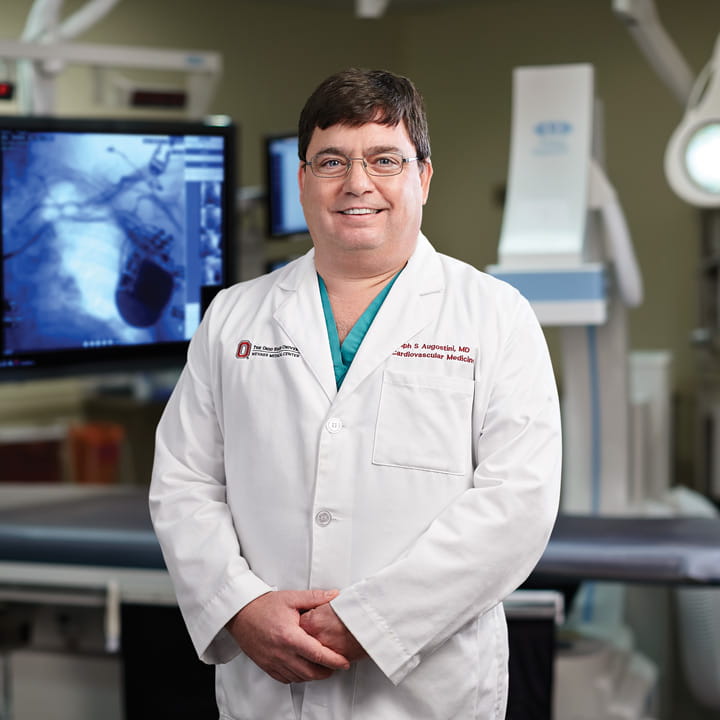
 At the electrophysiology laboratory in The Ohio State University Wexner Medical Center Richard M. Ross Heart Hospital at The Ohio State University Wexner Medical Center, cascading opportunities born of new research and technology are driving novel methods for lowering stroke and postoperative risks, shortening procedure times and creating more durable and customized solutions for people with arrhythmia.
Ralph Augostini, MD, the Bob Frick Chair in Cardiac Electrophysiology and section director of Clinical Cardiac Electrophysiology, leads a team of 11 electrophysiologists. They are using advanced mapping and ablation techniques, including pulsed field ablation (PFA), radiotherapy and artificial intelligence (AI) to better target tissues underlying atrial fibrillation (AFib) and ventricular tachycardia. They’ve also been working on miniaturized leadless pacing devices that overcome key problems with both traditional pacemakers and implantable cardiac defibrillators.
A novel atrial fibrillation ablation technique
Over the past year, electrophysiologists at the Ohio State Richard M. Ross Heart Hospital have performed more than 5,000 electrophysiology (EP) procedures, including more than 1,800 ablations for AFib. Today, these procedures are shorter and safer thanks to PFA, a new high-voltage energy method in which atrial cell membranes are selectively disrupted, sparing adjacent tissues. Artificial intelligence mapping techniques also identify and eliminate additional foci (localized clusters of abnormal heart cells) that trigger AFib.
John Hummel, MD, performed the first PFA ablation in the United States in a clinical trial at the Ohio State Wexner Medical Center, and has been the lead investigator for AI mapping and ablation of AFib. These technologies are now commercially available.
Procedural time has dropped from two to three hours to less than an hour, and procedural-related risks to adjacent tissues are reduced. Patients are experiencing safer, faster procedures with more durable results.
“Pulsed field ablation has completely revolutionized our ablation procedures over the past year. Prior to PFA, we used thermal ablation, like radiofrequency or cryoablation, in 99% of our AFib ablations. Now we use PFA in approximately 90% of the cases,” Dr. Augostini says. “We’re also using it for ventricular tachycardia and can use it under compassion-use designation for refractory ventricular fibrillation.”
Concomitant LAA closure and ablation
To help ensure against thrombus in the left atrial appendage (LAA), closure devices like the Watchman are increasingly offered to patients at the Ohio State Ross Heart Hospital. A recent clinical trial has demonstrated the value in combining AFib ablation with placement of an LAA closure device at the same time.
“Half of each procedure is virtually the same,” Dr. Augostini says. “Medicare has approved it, because it is less costly and it saves the patient from risks associated with a second procedure.”
Currently, it’s used for people either with contraindications or an aversion to long-term anticoagulants.
Conduction system pacing and leadless pacing
 Through a new technique of pacing the heart's left bundle branch, Dr. Augostini’s team is helping patients who’ve had pacemaker-induced cardiomyopathy and heart failure recover heart strength. They performed the first procedure with this technique in an implantable cardioverter-defibrilator (ICD) lead last year.
It involves positioning the ventricular lead within the interventricular septum adjacent to the left bundle branch. Pacing in this location enables the electrophysiologist to restore the natural conduction system to keep ventricular activation synchronized.
In addition, the electrophysiology team is now delivering a 1-inch-long Micra pacemaker via the jugular vein in the neck, where it’s affixed with tiny hooks to the interventricular septum of the heart. This avoids the need for a traditional pacemaker generator and allows earlier ambulation and less restriction during patient recovery.
This approach also addresses the risk of infections or lead fracture over years of use, which often requires removal and replacement of the traditional transvenous devices. New leadless pacing requires no wires, which decreases infection risk, and within a year the implants are typically encased by fibrotic tissue and are therefore inert.
“We’ve been a very high enroller, if not the highest, in the clinical trials completed to advance this technology and are a training site for physicians from other institutions on how to place leadless pacemakers,” Dr. Augostini says.
Importantly, future Micra pacemakers will overcome conduction anomalies as well. While a traditional pacemaker sends signals to the right ventricle, future leadless pacemakers will promote synchronous activation of the ventricles from the left bundle branch, avoiding risk of asynchrony and cardiomyopathy. Future leadless conduction system pacemakers will also be inserted through the jugular vein.
Complex ventricular tachycardia treatment
For patients with refractory ventricular tachycardia (VTach) or a history of life-threatening VTach storms (sustained ventricular tachycardia or fibrillation events), catheter radiofrequency ablation has been the gold standard. That’s being challenged by a novel approach. The electrophysiology team and the radiation oncology team are collaborating in a clinical trial to treat VTach with radiation, using MRI-based mapping to identify areas where they can create dense areas of scar tissue to block aberrant conduction.
“A huge benefit to this MRI-based radiation planning technique is that you can do it with the patient sitting in a chair for 10 minutes versus a three- or four-hour procedure under general anesthesia,” Dr. Augostini says.
Safer delegation of control to the patient
For many people avoiding continuous, long-term anticoagulants, the option may soon be available to monitor their heart rhythm remotely with a wearable device.
Salvatore Savona, MD, leads the team researching surveillance capabilities via Apple watches and is a major enroller in a randomized National Institutes of Health (NIH) trial comparing as-needed vs. continuous blood thinner use.
Sleep apnea, syncope addressed
Often associated with AFib, central sleep apnea and obstructive sleep apnea continue to rise, due to the aging population and persistent epidemiological factors. At the Ohio State Wexner Medical Center, collaborative research between sleep medicine and cardiac electrophysiology experts focuses on new methods for implants that innervate areas critical to functional breathing and sleep.
“We have been involved in phrenic nerve stimulator development for central sleep apnea from proof-of-concept through FDA approval,” Dr. Augostini says. “Now, we are investigating placement of transvenous pacing leads for treatment of mixed central and obstructive sleep apnea.”
In another advancement, the team is incorporating cardioneural ablation for neurocardiogenic syncope, the most common cause of fainting, as an alternative to medication or pacemaker implant. This treatment is highly effective for those patients who experience pause-related syncope events. By ablating neurologic ganglia adjacent to the atrial and pulmonary veins, it can resolve the exaggerated neurological stimulation that leads to pause-related fainting.
An exhilarating pace of advances
Dr. Augostini says he came to Ross Heart Hospital in 2006 to be involved in leading-edge advancements from proof-of-concept through clinical trials and release, and to teach other physicians on their application.
“EP is such a fast-moving field. We constantly have changes in the technologies that we use, and it is that mental challenge to be up-to-date and to be doing the latest and greatest things that keeps me coming to work every day,” he says. “We have had terrific interdisciplinary collaboration with our colleagues in heart failure, neurology, pulmonary, oncology and sleep medicine to facilitate novel technologies and pathways for complex patient care.”