
Ohio State’s new University Hospital improves physician teamwork and clinical care
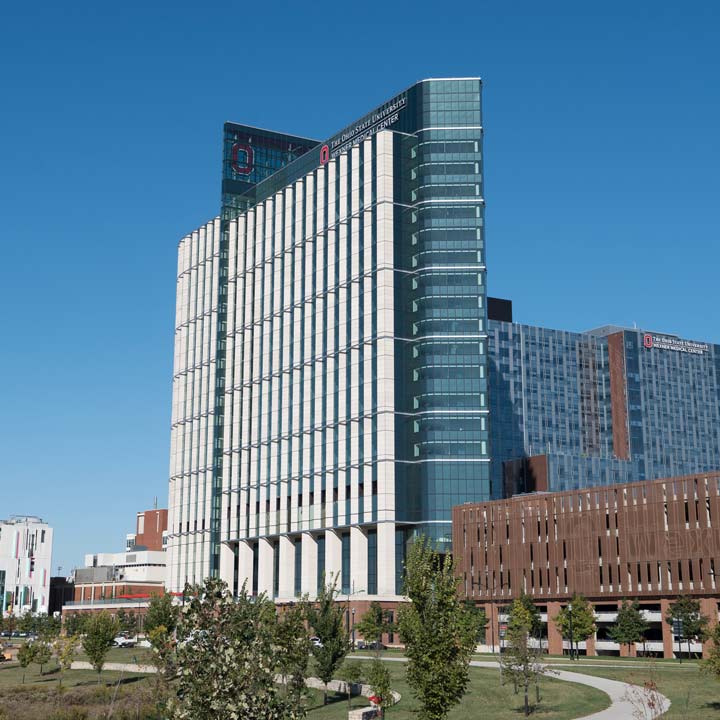
With the knowledge that care coordination is the backbone of every inpatient stay, leaders behind The Ohio State University Wexner Medical Center’s new University Hospital recognize its opening as a massive opportunity to rethink how multidisciplinary teams will operate and collaborate in 2026 and beyond.
The new hospital, set to open in early 2026, will feature a threefold increase in the number of University Hospital critical care beds, plus additional critical care beds for specific services, like The Ohio State University Comprehensive Cancer Center – Arthur G. James Cancer Hospital and Richard J. Solove Research Institute (OSUCCC – James), neurosciences and transplantation.
Transplant Center – a model for care coordination
The Comprehensive Transplant Center serves as a model for how hospital leaders across every department are reimagining team collaboration in the new 26-story tower to benefit abdominal transplant patients. Nephrology and hepatology will be alongside the Transplant Center on the 16th floor.
The unit envisioned for the future, where those departments will be in proximity, is designed to address the full continuum of care that abdominal transplant patients need. This proximity benefits liver transplant patients, especially, who tend to be more debilitated.
“They endure many of the functional limitations of other transplant patients and also suffer from bleeding and clotting disorders, which means they can’t risk falling without facing serious complications,” says Naeem Ali, MD, the medical director of University Hospital and a pulmonologist and critical care physician.
Community hepatologists depend on working closely with transplant physicians to support their patients, but until now, they’ve been located in a different unit from transplant services.
“In the new hospital, the full spectrum of services liver patients may need will be brought together,” says Dr. Ali.
In addition to improving collaboration, community nephrologists and hepatologists will now be able to refer more patients for transplant, as bed capacity in the new hospital for them increases from 43 to 60.
For kidney transplant patients, two additional biopsy bays have been added to the floor, allowing for prompt evaluation of early indicators of kidney rejection following transplantation.
Finally, the Transplant Intensive Care Unit (ICU) will be located together with the transplant unit, providing a more seamless transition for patients. This contrasts with most hospitals in the United States.
“We think that’s going to improve the quality and efficiency of care and outcomes,” Dr. Ali says.
Improved and expanded neurology care
Down on the 14th floor’s Neurocritical Care Unit, services for stroke patients are similarly expanding and improving, with non-ICU-level stroke care and ICU-level care located together in the same unit.
“Bringing the critical care together with the floor care provides for less movement for patients,” Dr. Ali says.
The new hospital includes a 25% expansion in bed availability for stroke inpatient care services. Diagnostic services such as computed tomography, electromyography and electroencephalograms are available via a quick horizontal trip from the neurostroke patient units. A rehabilitation gym on the unit facilitates stroke patients’ recovery and prepares those patients for discharge and aftercare.
On the same floor, the Epilepsy Monitoring Unit (EMU) is expanding and includes significantly improved technological capabilities. Like transplant and stroke care, the EMU will be located within the same space as the Epilepsy Surgery Unit.
“The referral patterns for those patients often get held up at the level of EMU capacity, so when more people can get in through that door for functional surgery, we’re increasing the pipeline of people in the community we can help,” Dr. Ali says.
Better critical care services for more complex cases
Critical care is expanding in capacity and ability. For the first time, all critical care services will be concentrated in one area, ensuring patients have access to the right care in the right location. Surgical, neurological and medical critical care services will be located one floor above each other.
“Really complex critical care requires cross-collaboration, expertise, technology and the knowledge of when to apply it. When there’s a complicated patient, there’s no question about our availability and ability,” Dr. Ali says.
Specialized services like transplant, neurology and critical care are only a sample of how the new Ohio State University Hospital will foster seamless transitions, increase capacity and enhance teamwork. Read more, and see details of the new hospital, here.
Learn how Ohio State’s new University Hospital will improve inpatient clinical care