
 What is a biophysical profile?
A biophysical profile (BPP) is a test done during pregnancy to check on your baby’s health. With the help of an ultrasound, your provider will measure your baby’s body movement, muscles, breathing, heart rate and amniotic fluid level, to calculate a BPP score.
This prenatal test may be performed with or without a nonstress test. A nonstress test tracks your baby’s heart rate as it responds to movement, while an ultrasound uses high-frequency sound waves to create an image of the baby.
The BPP is a score based on several factors that can give you and your healthcare team valuable insight into your baby’s overall well-being, especially if you have a high-risk pregnancy. At The Ohio State University Wexner Medical Center in Columbus, Ohio, our obstetrics team can help you make sense of the results of a BPP score and guide you in decisions regarding your pregnancy care.
Why is a biophysical profile test done?
You might schedule a biophysical profile test if there are some concerns about your baby’s health. It’s performed during the third trimester.
Reasons a biophysical profile test is done:
- Your pregnancy has gone two weeks past your due date.
- Your baby is moving less than usual.
- Your baby is measuring small.
- You're carrying multiple babies.
- You have an underlying medical condition, such as type 1 diabetes or high blood pressure.
- You have low amniotic fluid.
- You've had a stillborn baby or pregnancy complications in the past.
Don’t be overly concerned about scheduling a BPP, as your doctor may recommend the test even if no problems are suspected. Your doctor may, alternatively, perform a nonstress test (NST).
What does a biophysical profile test evaluate?
There are four different areas a biophysical profile evaluates about your baby:
- Body movement – The ultrasound will determine how much the baby moves, including fine motor skills.
Muscle tone – Any strength movements, such as opening of hands and mouth, extension of limbs or rotation of the trunk of the body, can be recorded using ultrasound. - Breathing – The ultrasound will make sure your baby has continuous, rhythmic breaths.
- Amniotic fluid – The volume of fluid is assessed during the test.
When is a biophysical profile done?
A BPP is typically performed between 32 and 40 weeks. Repeated BPPs may be scheduled once or twice a week for the remainder of your pregnancy, depending on your results and health history.
Risks of a biophysical profile
The BPP test is noninvasive and poses no risk to you or your baby.
What to expect during a biophysical profile
A BPP test typically consists of two parts: an ultrasound and a nonstress test. However, your provider may perform an ultrasound without a nonstress test. Both prenatal tests are noninvasive and painless.
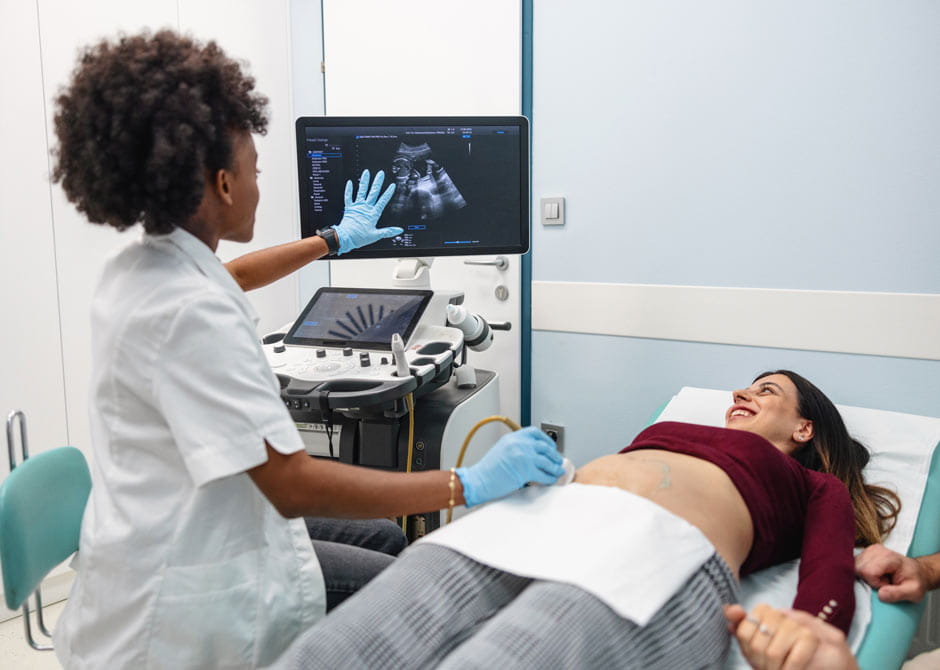
- Ultrasound: You’ll lie comfortably on an exam table while a provider performs an ultrasound to observe your baby’s movement, tone, breathing and amniotic fluid. During the ultrasound, a gel will be put on your belly, and a handheld wand will be pressed against it. Images of the baby will then appear on the screen next to you, and we’ll begin to assess the four components of the test.
- Nonstress test (NST): Following the BPP, the provider will complete an NST by placing sensors on your belly to track your baby’s heart rate.
How long does a biophysical profile test take?
Typically, the ultrasound lasts up to 30 minutes, and the nonstress test lasts up to 30 minutes.
Results of a biophysical profile
Results of the test should be available immediately. We’ll give you a score and discuss recommendations based on that number.
How is a biophysical score calculated?
Each of the four components of the test is given a score of 2 if it’s met. Here’s what must happen during the test to receive a full score:
- Movement: At least three separate body movements are observed over 30 minutes.
- Muscle tone: One or more muscle activities, such as limb extension or flexing, mouth opening or making a fist, are observed during 30 minutes.
- Breathing: The baby should have one episode of continuous breathing that lasts for 30 seconds during the test.
- Amniotic fluid: The fluid must measure at least 1 centimeter (cm) across and 2 cm vertically.
For each of these that is observed during the test, 2 points are added to the overall score.
What does biophysical scoring mean?
Each of the four components receives a score of 0 (not observed) or 2 (normal), for a total possible score of 8 points.
- 8: Normal. Your baby appears healthy.
- 6: Equivocal. Your provider may repeat the test within 24 hours.
- 4 or below: Concerning. Further evaluation or delivery may be recommended.
If your provider performs a BPP together with a nonstress test, your score will be out of 10 to measure all five components.
Your provider interprets these results in the context of the baby’s gestational age and overall pregnancy health. Any score less than 8 indicates that your provider will need to conduct additional testing of the baby. Don’t panic if your baby scores less than 8 points. Several conditions can impact your score. It just means your baby will need more testing.