
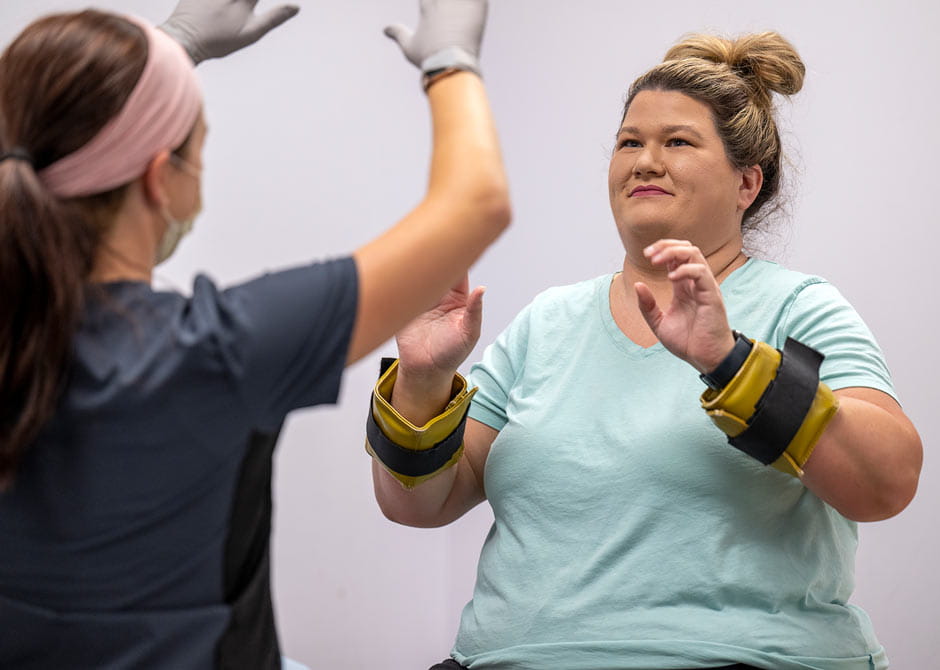
 People who experience a traumatic brain injury or other damage to the brain hope to regain as much function and independent movement as possible through their rehabilitation. Sometimes a major barrier to achieving that goal is spasticity or muscle spasms.
The Ohio State University Wexner Medical Center in Columbus, Ohio, is a leader in treating people with spasticity and helping them manage it through various therapies, devices and medications, so they can improve their quality of life.
What is spasticity?
Spasticity refers to stiff or tight muscles with exaggerated stretch reflexes. This condition can make it difficult to move, walk or speak. Spasticity is common among people with diseases of the nervous system or those who experienced damage to the part of the brain that controls voluntary movement. Someone with spasticity management issues may experience:
- Muscle tightness or stiffness, making it difficult to do certain tasks
- Muscle spasms, which are quick and involuntary muscle movements
- Tremors, or clonus
- Pain or discomfort related to muscle stiffness
- Poor posture
- Permanent contraction of muscles
- Involuntary crossing of legs
- Muscle fatigue
- Joint, bone or muscle deformities
- Issues related to urinary and bladder function
- Difficulty sleeping from stiffness, spasms or discomfort
Spasticity can disrupt many aspects of your recovery and overall life, so it’s important to work with physical medicine and rehabilitation experts to improve and alleviate symptoms of spasticity as quickly as possible.
Who can benefit from our spasticity management program?
Anyone who experiences symptoms related to spasticity can benefit from medical management by our physical medicine and rehabilitation experts. Our program treats people with these conditions and more:
- Brain injury
- Dystonia
- Cerebral palsy
- Hereditary spastic paraparesis (progressive weakness and stiffness of the legs)
- Multiple sclerosis
- Spinal cord injury
- Stroke
Spasticity management services at Ohio State
Spasticity management experts at the Ohio State Wexner Medical Center provide comprehensive care for people with spasticity at every level of care, whether you’re receiving inpatient or outpatient rehabilitation.
Treating spasticity often requires a multidisciplinary team collaborating to develop a personalized treatment plan that works for you. Following a physician referral to our spasticity management program, we’ll recommend various treatments and therapies to help reduce and control your spasticity. Some of these services may include:
- Medical evaluation
- Physical therapy to help patients improve strength, mobility and fitness
- Occupational therapy to help patients participate in activities of daily living
- Speech or swallowing evaluations as influenced by spasticity, and application of techniques to ease or manage the difficulty
- Exercise programs, including aerobic and strength-building
- Oral medicines to help with muscle spasticity, including baclofen (Lioresal®), dantrolene (Dantrium®), diazepam (Valium®) and tizanidine (Zanaflex®)
- Splints, casts, braces or other assistive devices to help relieve muscle and tendon tightness and modify various nerve-muscle pathways that contribute to spasticity
- Injections of Botox® (botulinum toxin A) or other neurotoxins, which relax muscles and reduce excessive muscle contractions
- Baclofen pump therapy, which is a programmable device that delivers medication directly to a targeted site in the spinal cord
- Surgery
Often, treating spasticity and related symptoms will take a combination of these therapies administered over a period of time to see improvements in your symptoms.
Why choose Ohio State for spasticity treatment and management?
Ohio State’s rehabilitative care can help relieve spasticity and related symptoms, including pain, impaired mobility, disrupted sleep and more. Here’s why people choose Ohio State for care related to spasticity:
Nation’s best: Ohio State’s physical medicine and rehabilitation program consistently ranks among the best in the nation. As an academic medical center, Ohio State offers comprehensive medical expertise, the most advanced technologies and treatment techniques, and innovative care backed by research knowledge.
Personalized care: You will receive a personal evaluation that helps create an individualized care plan to meet your needs and lead you toward your health goals. We’ll help you learn the skills and techniques you need to improve your abilities at work, at home and in social settings.
Unique services: Ohio State is a leader in the use of the Baclofen pump, an aid for decreasing spasticity. In addition, our program has a 10-year history of proven results using Botox and other injection therapies. We also use electromyography (a test of the electrical activity of muscles), ultrasound guidance, and neurostimulator control (mild electrical signals) to guide our injections. Our physical, occupational and speech therapists have extensive experience in the practical application of rehabilitation techniques and interventions for people with spasticity.
Certified excellence: Our brain injury specialists are nationally certified by the Academy of Certified Brain Injury Specialists, which establishes best practices for brain injury rehabilitation, including spasticity management. Many of our physical and occupational therapists have neurologic fellowships, and our staff has experience derived from years of specialization and collaboration with colleagues at leading brain injury centers in North America.
Continual research advancement: As a nationally recognized model system for treatment and research of brain injuries, you’ll receive the most advanced treatments and therapies backed by research knowledge and have access to the most recent data from long-term studies of people with brain injuries. Millions of dollars come to Ohio State annually to further the study of preventing, diagnosing and treating brain injuries.