
Stroke Rehabilitation
Ohio State’s Stroke Rehabilitation Program can help you regain function, mobility and confidence during your stroke recovery.
What is the Stroke Rehabilitation Program at Ohio State?
When a stroke abruptly alters your life, the Stroke Rehabilitation Program at The Ohio State University Wexner Medical Center supports you through every step of reclaiming your function and maximizing your independence.
From acute rehabilitation just after a stroke to long-term personalized outpatient rehabilitative care, our compassionate experts remain your continuous partners, providing unwavering support throughout your recovery. We offer the most advanced, evidence-based stroke rehabilitation therapy, pain management, treatment and technology to get you back to the things you enjoy.
Inpatient care takes place at the nationally ranked Dodd Rehabilitation Hospital at the Ohio State Wexner Medical Center in Columbus, Ohio. As you transition home and back into the community, you can continue outpatient rehabilitation under the care of your same doctor at one of our conveniently located therapy offices and gyms spread across central Ohio. Our Stroke Rehabilitation Program is accredited by the Commission on Accreditation of Rehabilitation Facilities (CARF), which means we’ve achieved the highest standards in quality, safety and outcome measures. We’re the only rehabilitation program in central Ohio certified for both traumatic brain injury (TBI) and stroke.
Rehabilitation is full of setbacks, but it’s also full of hope. Our stroke recovery team supports your journey to improved quality of life.
Who is a candidate for the stroke rehab program?
Our stroke rehabilitation program is designed for adults of all ages who are recovering from a stroke and need to regain function, mobility and independence.
You may be a good candidate if you’ve experienced:
- A hemorrhagic stroke (related to a blood vessel leak and bleeding in the brain)
- An ischemic stroke (related to a blocked blood vessel and lack of blood flow to the brain)
- Disorders causing damage to the brain (multiple sclerosis or brain tumors)
Finding the right type of stroke rehabilitation
Whether you’re transitioning from an inpatient hospital stay after a stroke, need outpatient therapy or are looking to reduce the risk of future strokes, our rehabilitation center for stroke recovery can help you meet your goals.
Our team will conduct an assessment and recommend a personalized care plan that is tailored to your specific rehabilitation needs and goals and coordinated by a case manager.
Inpatient stroke rehabilitation
If you experienced a moderate to severe stroke, you may need inpatient rehabilitation care at Dodd Hospital, where you’ll stay for several days or weeks, working with various providers and therapists to improve your function and help you physically and mentally manage any disabilities. Our team of specially trained and certified physical medicine and rehabilitation experts will support you through high-intensity therapy to return you home and begin outpatient rehabilitation safely.
We also focus on teaching members of your support team the critical skills they need to be confident in supporting you at home.
Outpatient stroke rehabilitation
The majority of your stroke rehabilitation takes place in outpatient rehab. Once you’re medically stable and able to actively work with your therapists, outpatient therapy can help you through recovery and the process of adapting to stroke impairments and achieving higher function.
What to expect during your inpatient stay at Dodd Hospital
From the moment you’re admitted to inpatient rehabilitation care, our compassionate team of stroke experts focuses on helping you achieve your personal goals. Inpatient intensive treatment is like a boot camp, with at least three hours of therapy daily, five days a week. We work closely with you to provide the intense rehabilitation therapy that prepares you to continue outpatient rehabilitation.
We regularly see people come to inpatient rehab barely able to wiggle a toe and then leave confident enough to function at home safely.
Average length of stay for stroke patients
The average inpatient stay for stroke rehabilitation is about 12 days, depending on your functional needs, severity of impairment and available home support.
For example, if you have no movement in your arm or your leg, your inpatient stay may be three to four weeks. For mild weakness, where you’re mainly working on balance and coordination, your stay may be between seven and 10 days.
Take our stroke quiz
Are you at risk of a stroke? Find out now with our online questionnaire.
What to expect for your stroke recovery
Recovery from a stroke takes time, but every step is a building block. Our rehabilitative team supports you to help you overcome a wide range of stroke complications, including spasticity, pain, mobility, cognitive, language and swallowing issues.
You’ll also have access to specialists within the Ohio State Wexner Medical Center, including neurosurgeons, neurologists, neurointerventional radiologists and gastroenterologists, to support all your medical needs.
Throughout your recovery from a stroke, we focus on how you can still have a high-quality life –– even if it looks different. Despite experiencing this neurological injury, you’ll learn how to still feel like yourself, be as independent as possible and enjoy life.
How we help
After a stroke, everyone experiences different symptoms and severity. Some common ways we help include:
- Neuroplasticity: Help to rewire your brain to take over the functions of the areas damaged by a stroke
- Strength and mobility training: Physical therapy to improve movement, strength, balance and coordination
- Communication: Speech therapy to improve language skills, understanding, thinking, memory and attention
- Swallowing: Therapies to evaluate and treat swallowing difficulties, and design strategies or diets to keep patients safe
- Vision evaluation: Specialty vision services offered by a neuro-optometrist in our neurovision clinic designed specifically for people with neurological disorders
- Regaining independence: Improvement of daily activity skills, such as getting dressed and performing personal hygiene tasks
- Skill development: New strategies to compensate for functional challenges so you can return to daily life, including cooking or cleaning and even leisure activities
- Pain management and spasticity: Treatment for stiff, painful, rigid or contracting muscles, to increase your mobility and reduce pain
- Social and emotional support: Support, including rehabilitation-specific mental healthcare, to cope with life changes that follow a stroke, including your mood, relationships, independence and confidence
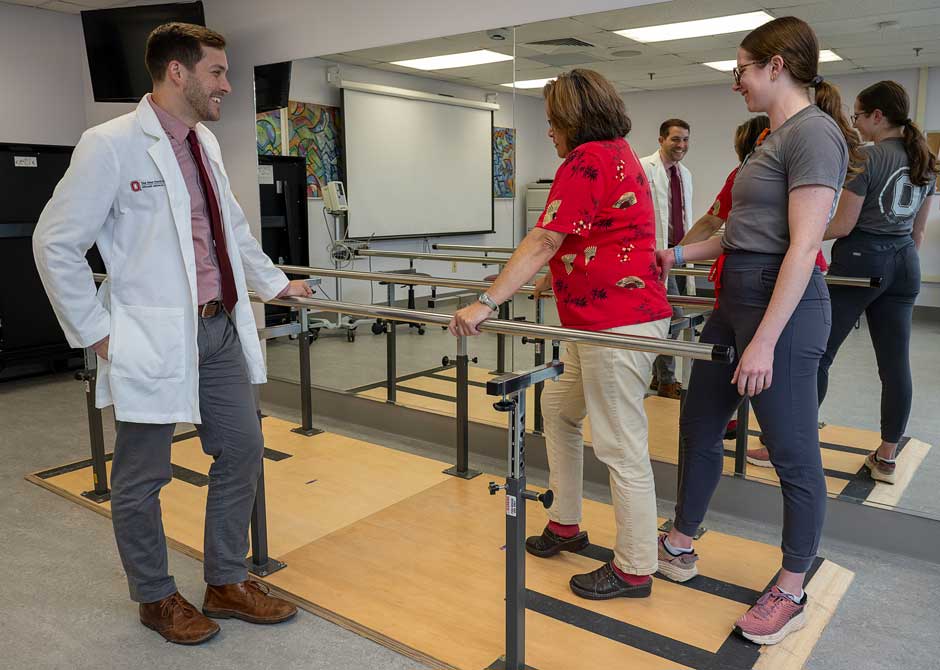
Rehabilitation doctor brings hope, healing to patients after stroke and trauma
Timothy Hake, MD, leads rehabilitation at Ohio State by giving focused, compassionate care to each patient.
Outcomes for stroke patients
Unparalleled experience
The stroke rehab program served 233 people with inpatient services at Dodd Hospital in 2024, and 374 people with outpatient services.
Better outcomes
Roughly 72% of people in the stroke rehab program at Dodd Hospital were discharged back home. Functional improvement of self-care and mobility increased on average from a score of 60.96 at admission to 97.26 at discharge.
Patient satisfaction
Roughly 96% of people with a stroke agreed or strongly agreed that inpatient rehabilitation improved their quality of life, while 100% of people in outpatient stroke rehab felt therapy helped them.
How we work together to support your stroke rehabilitation
Recovering from a stroke requires a team of experts who seamlessly collaborates to support you with skill and kindness. From intense occupational therapy and physical therapy for stroke rehab, to neurological pacemakers, and Botox® for spasticity, our Stroke Rehabilitation Program supports every phase of your recovery from a stroke.
Walking, for example, requires multiple muscle groups, balance and coordination. Each component is integral to the other. Relearning to walk may require these team members:
- A physical therapist
- A physician
- A neuro-optometrist
- An occupational therapist
- A rehabilitation psychologist
Specialized therapies
Our team of stroke therapists collaborates closely to create a personalized treatment plan that helps you regain strength, mobility and independence.
- Physical therapy: Our specially trained neurorehabilitation therapists are experts in providing care for stroke recovery. They work with you to improve strength, mobility and fitness, using aids like walkers, braces and advanced technology.
- Occupational therapy: Occupational therapy for stroke helps you get back to doing your activities of daily living. This can include relearning skills like medication management, money management, household chores and safety. Therapists use real-world simulations, such as a working kitchen, or even visiting a nearby restaurant.
- Speech therapy: Our team of experts helps you regain your voice, understand others and safely eat and drink again.
- Additional therapies include art therapy, vision therapy, recreational therapy, music therapy, cognitive therapy and more.
Advanced technology
We use state-of-the-art equipment to aid your stroke recovery, including:
- Functional electrical stimulation (e-stim): When you can’t open your hand or move your arm, e-stim stimulates your muscles by reinforcing nerve pathways in your hand or arm.
- Walking aids (Bioness®): These devices, such as the patented Bioness, stimulate nerves to help with ankle movement, improving walking mechanics and reducing the risk of falls by clearing the foot during the swing phase.
- Body weight support systems: These systems operate over a gym track and treadmill to offload your body weight, facilitating walking mechanics and helping you overcome fear of falling.
- Neuromodulation: Neurological pacemakers deliver electrical signals, medications and other therapeutic agents precisely into your brain, spinal cord and nervous system.
- Videofluoroscopy: This special X-ray helps indicate how you swallow. It’s a quick, painless test that shows what’s happening in your mouth and throat when you eat or drink.
- SaeboFlex® technology: This hand orthotic helps you overcome moderate to severe spasticity, which is when your muscles involuntarily contract, allowing you to grasp objects again.
- Flexible endoscopic evaluation of swallowing (FEES): Many of our speech therapists are certified in the use of FEES, which involves passing an endoscope through the nose to look for any issues that may be causing your dysphagia, or difficulty swallowing.
- Specialty dysphagia treatments: We have interactive swallowing and speech exercises that are combined with surface electromyography (sEMG), which is a noninvasive technique for measuring muscle electrical activity, to improve swallowing mechanics and normalize muscle function.
Additional services and programs
- Driver rehabilitation program: This evidence-based program can help you regain the skills and confidence you need to get back behind the wheel after a stroke.
- Spasticity and pain management: Given in very small amounts directly to a specific muscle, Botox can block the transmission of certain nerve impulses, helping relax common muscle spasms after a stroke. Using Botox to treat muscle tightness, pain and spasms was developed by Ohio State researchers as an important stroke rehab therapy.
- Return-to-work training: This program helps you develop the specific skills necessary to achieve the functional independence required for your job.

Recovering from a stroke: How long does it take?
Matthew Gusler, DO, a vascular neurologist at The Ohio State University Wexner Medical Center, explains that recovery from a stroke varies from person to person. The most rapid period of recovery is the first three months after a stroke.
Why Ohio State is among the best in the nation for stroke recovery
Ohio State’s rehabilitation program consistently ranks among the best in the nation. With the most advanced technologies, evidence-based treatment and innovative care backed by research knowledge, we provide the support and resources you need to overcome stroke damage. Here’s why people choose Ohio State for stroke rehabilitation:
Continuity of care: Recovering from a stroke is a marathon, not a sprint. Our team of experts supports you, beginning with emergency services and continuing through inpatient therapy and outpatient services after your hospital discharge. Many people continue to receive long-term care, such as treatment for spasticity, from leading stroke recovery experts.
Personalized treatment: Since every stroke affects individuals differently, your treatment plan and therapy should be tailored to your specific needs. Based on initial and ongoing evaluations, your team will develop and follow an individualized care plan to help you achieve your health goals.
Access treatment where it was developed: Our rehabilitation specialists have pioneered important stroke rehab therapies used at hospitals nationwide, including Botox to help treat muscle spasticity. Throughout your care, you’ll benefit from working with staff who have specialized training and certification in stroke-related treatments and therapies.
Medical Director
Timothy Hake, MD
Medical Director, Stroke Rehabilitation Program